Antonius Kho was born in Klaten, a small town of
central Java. Central Java is a boiling pot of art and culture, in the area. Antonius’s
sources of inspiration are multiple. Batik designs and the figures of the
“Wayang” puppet show theater have probably provided his visual memory with the
notion of pattern. Antonius became interested in Batik making in Yogyakarta and
learnt it. He obtained art education in Germany, at FH-Cologne Art Academy by
majoring in glass paintings and textile art-tapestry. He does artworks such as sculptures and
paintings. His works is a synthesis of mosaic and textile art. His techniques
are a combination of that of painting, batik making, in collages arrangement
producing field intersection. Antonius borrows the ethnographic images to
recreate a meaning for his own use instead of the symbols. The subjects in
Antonius’s works are mostly about the mosaic of his life, the people around his
life, he work with various phases. It is almost like a circulation of his life.
He is inspired from the life of nature and it plays the main role concerning
color in his art works. Antonius Kho
combines the Europeans influence of colors with that of batik. The beautiful
nature of Indonesia and Java can be seen in his paintings as the animals like
elephants and other pets. His approach
of formal restructuring of his patterns into modern compositions is as a result
of the exposure to international art and learning from Germany. He uses various
technique in his works. He tries to manipulate different elements such as
materials, techniques, nature of materials used and media development.
Materials gain importance in his works. Along with colors such as acrylic
colors he uses different kinds of materials such as rags, jute, rope or string,
modeling paste and transparent paper not only attached together to give
artistic flavor but also to create a sense of power and objective. It looks
like 3-dimensional, because he likes cubism. Decoration is skillfully and
intensively done indicating a strong desire to produce artistic possibility. In
the end, his very characteristic lies on fields’ compilation, maintaining line
effects and colors. Antonius’s works are mosaic consisting of vignettes of
tropical and earth tones scattered across the canvas in an obsession patterning
of human figures and masks. When looking at it, though, it is impossible to
focus on these individual patterns or sub-patterns, one’s attention is drawn
away, made to run from one color surface to the other like a dance across the
canvas from one tone to the other. Eyes lurk everywhere in his art works,
almost like the large eyes of Wayang puppets or the all seeing eyes. His
paintings are figurative while having the formal qualities of abstraction. They
can thus be interpreted at both levels, without the one interfering on the
other. One may let oneself be either haunted by the weird presence of the
"eyes" and masks or entranced by the hypnotic quality of the color
patterns. Antonius realizes that his
life is divided into two cultural domains, i.e. in one year he has been exposed
to European and Indonesian culture which has made him unite the two in his
framework of mind. He tries to reconcile the contrasting West and East.Antonius
Kho now shares his time between Cologne and Ubud, Bali, and exhibits regularly
both in Europe and in Indonesia.
Saturday, May 8, 2021
Antonius Kho
Thursday, February 25, 2021
Resul Jusufi
An attempt to read or find meanings in an abstract art can be as tricky
as trying to understand the song of a bird. Many abstract artists just go with
the flow of their mind and mood. Some artists try to bring out meanings in
their abstract art. The experience varies between viewers based on what the
viewer is seeing or feeling.
Artist Resul Jusufi is a social person. He loves travelling and living
in different places for few years and then moving on to new place. His dream is
to settle in United States of America. His abstract art has a lot to do with
social themes which he portrays in his different forms of creative works. These
may be about people living in cities, or maybe the need for people to reach out
to each other, or the attachment of people to their positions or occupation
etc. He depicts his sociological thoughts and emotions towards such subjects
through the colors, abstract forms, words or numbers. The chaos of the city and
the positivity amidst that can be seen in the abstract cityscapes of artist
Resul Jusufi. The portal to each home is the door, but the windows provide the
sneak peak to the world inside the sanctuary called home. Though it is the
tangible living beings that make a building a home, the intangible element of
their thoughts, dreams, desires, intellect etc form a different level of psychic
world. Today most of the living and nonliving beings have a numerical or
digital identity associated with numbers or codes, such as the social security
numbers or individual identity numbers for individuals, codes for objects etc. It
is also a world where numbers in various forms like phone numbers, street
numbers, codes etc gets importance. With these numbers emotions too are
attached at times. For eg. The happiness associated with seeing the telephone
number of one’s beloved or to the date when one’s salary gets credited, the
stress on thinking about the amount of loan etc. A world of color, numbers,
logic all leave their prints like foot prints of our existence. The search for
love, freedom inspite of the bondages of the emotions of a chaotic world finds
its way through the portals amidst the colors like the sneak peek into lives
inside homes in high rises seen through the windows and doors. These words or
phrases like “Good Things are coming” give a feeling of goodness amidst the
chaos in his cityscapes; like an oasis in a dessert. The colours reflect his
feelings about the nature, certain psychological or spiritual state. Winters
flow in to his cityscapes in whites and greys; while springs through greens.
It is not just cityscapes he paints. Resul says that he paint feelings,
not just objects and nature. He paints feelings about nature, one object, or
one situation that has happened in his life. Resul is an artist who is
extrovert and loves being with people. He says human beings cannot live without
each other’s company and in seclusion. The social commitments, behaviour etc.
makes human a social being. In our childhood we have friends in school,
neighbourhood etc. but as we grow up in some cases our friend circle reduces.
Reasons can be many, but knowingly unknowingly we start becoming more lonely or
selfish. Sometimes people even become lonely due to reasons such as losing
their dear ones, bitter experiences in life, due to sickness and old age. It is
hard to be alone. We think lesser about others or bother to understand or help
others. As the phrase “to put in another’s shoes” suggest we should try to
think about things/events by trying to being in the other person’s position. This
empathetic attitude helps a lot to change one’s attitude. This can many times
reduce tensions and the causes of quarrels etc. When somebody is suffering or
going down in life, one should give the person a hand or a chance. Such an
action can make the world a better place to live. Resul has also collaborated his art works with
his short films and theatrical workshops. One such collaboration is in lines
with his short film “The Alone Shoes”. This 3 minutes long short film focuses
on the shoes of people walking with single footwear while holding the other, in
a small place. There is a single shoe left in the centre of the place. By the
pace of the walkers it does not look like anyone bothers about the single shoe. After some busy paces they circle around the
single shoe and one of them picks the shoe. Then they start exchanging the
shoes amongst themselves. In the end all wear odd pair of shoes. Love and
understanding spreads amongst them.
To express about loneliness the artist created an artistic installation
using different types of shoes of different colors and types. The shoes were
arranged also according to gender and put in different artistic forms on the
walls of the gallery. Shoes were installed inside three wooden frames of
different sizes. Outside the tableau is the lonely shoe. Some of the shoes put
without frames also some of them will be put on some boxes and the others up at
ceiling using a rope net. Another of Resul’s art works is in the form of an
installation clubbed with his abstract painting background. In this artwork
there is a large cloth canvas with lot of black footprints depicting the
movement of a crowd, while a single shoe lies outside the canvas. This
installation conveys the same meaning as that of the short film. There are
other art installations in the same theme of “The Alone Shoes”.
Through his abstract works Resul
conveys to the onlooker to focus on good things in life such as love, trust,
hope etc., to understand, support one another so as to make the world a better
place.
Resul Jusufi was born in 1968 in Kosovo. He has studied at the Technical Faculty of the University of Pristina (Kosovo), at the Academy of Arts in Tirana (Albania) and at the Academy of Film and Television in Warsaw (Poland). His surrealist book was published in 1995 in Tirana. He founded several theatre groups, realized several theatre plays. Other forms of artistic presentation include installations, performances and theatrical workshops. Twenty years ago, he found his way to abstract painting and since then has participated in many individual and collective exhibitions. His art presentations are popular in Kosovo, Albania, Poland, Switzerland, France, Belgium, Netherlands, Germany and Austria. He presently lives in Graz (Austria) since 2017.
Friday, February 12, 2021
Tiarma Sirait
Tiarma Sirait is a Bandung-based painter & fashion artist who aims to support diversity in Indonesian painting & fashion art through active participation in the local & international art scenes. She began to study painting from the Indonesian senior artist: Barli Sasmitawinata when she was in Junior High School. Later she continued her academical studies in the Bandung Institute of Technology (ITB) in Textile Design, Royal Melbourne Institute of Technology (RMIT) in Fashion Design & a STINT (The Swedish Foundation for International Cooperation in Research & Higher Education) scholarship Program, Master in Fashion & Textile Design at University of BorĂ¥s, Sweden. Her painting & fashion performance has been acknowledged by many international arts institutions. She has intensively participated more than 300 exhibitions in many domestics & overseas exhibitions. Tiarma has received many astonishing awards in Creativity Designs & Art Awards from many countries.
Tiarma has worked quite consistently with pink since the beginning of her career as a painter & fashion artist in 1998. Her artwork uses pink as the main color. She uses this color to give an eccentric sensation for her creation. She used pink also because the color is very girly, kitsch, synthetic. Tiarma has brought up pink plastics & synthetic fur to highlight the fickleness, volatility & falsehood that permeate our dearly held beliefs, influences & lifestyles. It has been her signature to use this brilliant color in her artwork.
Through
her bold conceptual approaches to art, fashion design & pop culture, Tiarma
has explored themes such as love & lust, foreign influences on Indonesian
culture & mass consumerism to name but a few. Her art is intended to show
the hyper reality in the contemporary context.
Saturday, January 23, 2021
Jackie Lima- A Migratory Artist
American artist Jackie Lima have been to India a few times, meeting and working with Indian artists, residencies and exhibitions. Her grandparents were world travelers. They traveled on Cargo ships that stopped in many ports. Jackie had the (colonial) names of Indian coastal cities imbedded in her brain with slide shows to accompany each one. Following the art opportunities, Jackie have been to each of those cities and experienced them in her own way…through Art. She felt a different India when she visited india again 50 years later.
About her works
Her work is informed by the experience
of Space. That experience is Omnipresent. Looking at and thinking about it in
different ways has led me to finding forms for painting that can address the
flattening of space on a 2-Dimensional surface, and the wrapping of it onto a
3-Dimensional surface, as well as works that imply the 4th Dimension. Since
Jackie is visually discussing the space she is looking at and standing in, her
SELF in the space is included or implied by the process.
About her current art works.
She said that her ancestral family
arrived in the New World from England through Leiden, Holland, in the 17th CE.
She is working on an Interactive piece about this right now. This piece depicts
her family homestead in New York State and discusses America’s Welcome of
people from all parts of the world to come here and participate in the Great
American Experiment. Others will share their family stories as well, completing
the piece.
She feel as though Democracy, Freedom
and Rule of Law -the right of equal access to justice for all – were born in
her own Heart.
Wednesday, January 20, 2021
Nature in Claudio Giulianelli's Imagination
Claudio Giulianelli
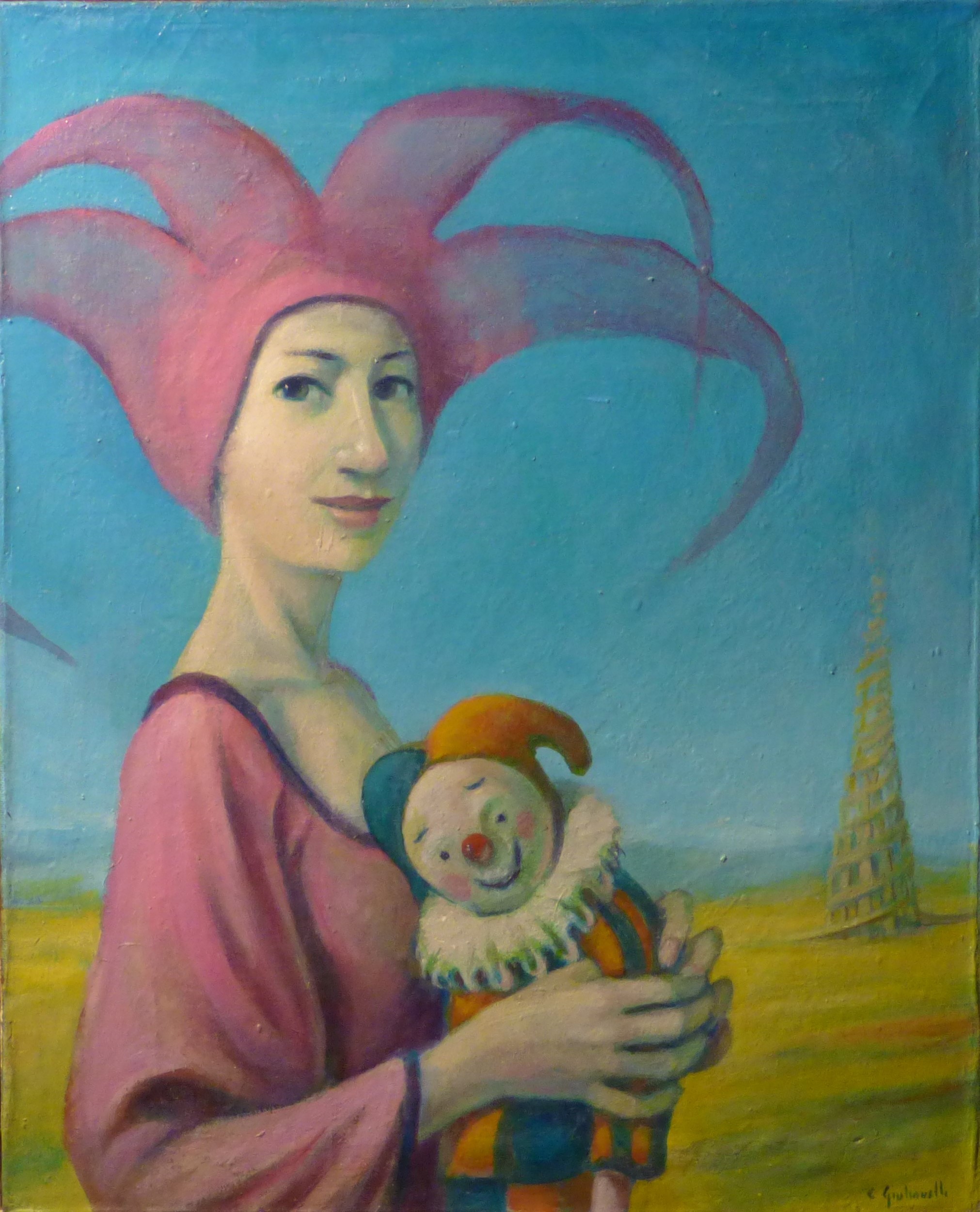
Claudio Giulianelli is a Roman artist who have done many major exhibitions in different parts of world and been in biennales. Most of his pictures, represent feminine subjects. They are mixture of reality and imagination, dream and mystic, memories and symbolism. These paintings have elements of Impressionism, Symbolism and Surrealism. His strong passion for art (in particular for the ancient one) led him to deepen the technique and study of painting through a careful observation of the works of the Masters together with the reading of texts of pictorial technique. Claudio despises the part of world where hypocrisy, chaos and confusion seems to predominate over good. Therefore he finds home in his own universe, a place where he experiences mystery and fascination. These paintings seem to express about the contemporary human behaviour and conditions. It looks like they suggest a sweet and quiet period of hybernation, opposing reality in order to discover peace and serenity.
Paintings of Claudio
The message that this artist
seems to convey is one of regaining the true dimension of the existence through
history and ourselves. The inspiration to the antique represents for this
artist the opportunity to free his mind and create images that cast themselves
to a new time of revolution in graphics.
Claudio Giulianelli was born in
Rome on September 23rd, 1956 He lives and works in a very small town of
Etruscan origin named Corchiano, located near Rome. Since childhood he used to
draw masks, jesters and clowns. He was obsessed with clowns. The dames in his
paintings represents nature. They are drawn as beautiful and
imposing. Shelooks upon the observer as if a queen. Whereas he draws the man as
small figure like a puppet in the hands of nature. The man or puppet tries hard
to define nature to understand her. But it is a hopeless task, a heroic task.
[Translation of this post into
malayalam was published in Bindu P V's Column on Art and Times in the
Prasadakan Monthly Magazine in Malayalam.]
Photos of the article published in 'Prasadakan' Monthly Magazine, in Malayalam language.
Sunday, October 18, 2020
Gopi Mangalath
There are many people who don multiple
feathers in their hat. Versatile creative persons would be such people.
They are not bound by their field of studies or their job, in whatever they do.
They understand well that sheer creativity do not bring in bread always. One
needs food always, bills needs to be paid. The concept of certain blue blooded
critics and artists that the profession or studies of a person
influencing/affecting their work and resulting in substandard works dosent
bother these realistic and self respecting breed of creative people, who are
willing to try out whatever that sets them free. Gopi Mangalath is one such
person. He is a creative director, movie director, visual artist, writer,
poet and columnist. He is a publisher too with Golden Jokes Books and Monthly.
He dedicated his life for the new and unique ideas in arts and literature. He
is a graduate of Botany, as well as Applied Arts ( BFA Applied Arts, from the
Government College of Fine Arts in Thiruvananthapuram). Experimentation with
texture, style, size, shape and colours are Gopi’s forte. He has conducted 8
exhibitions on paintings and sculptures and also participated in Kerala state
Lalithakala Academy’s annual exhibition and painters camp etc. He received
award for the Logo of Kochi Smart City. He has three Limca Book of World
Records for First One Line Stories, First Film Role Book Design and First
Abstract Film. He wrote the concise history of Cinema in miniature size in the
form of a film role. The Abstract film by him is a murder mystery created
without any title, dialogues or any animal, birds, human beings or not even an
ant; but with a clear story line and characters. He also has 2 Best of India
records. His poetry "Sterile Feelings' was translated and published into
'Poet', an the Intercontinental magazine . He wrote a column on visual art in a
Malayalam newspaper's Sunday supplement for a year and his programmes have
featured in TV and radio.
First film role book design that won him one
of his three Limca Book of World Records.
One of his interviews
Logo designed by Gopi Mangalath for White
Sanctum Art Gallery
Face of White Sanctum series of facebook
based online exhibitions post designs designed by Gopi Mangalath
Gopi's creativity flows into various areas of art and literature. Bringing out novel methods in everything he deals with. He experiments with different styles of art... He doesn't look far for inspirations. His references are from things nearby. The cattle that graze in the nearby plots graze on to his colors and forms. His cow series of works have found much appreciation from galleries and connoisseurs.
He also makes images inspired from local
religious or ethnographic contexts and depicts them in his way giving respect
to the image.
[Images courtesy: Gopi Mangalath]
The artist, though from applied arts
background and with work as a publisher etc to be sustainable, gives his best
when he turns to art, whenever he can. He have been closely observing the art
of many artists in Kerala consistently since past decades and that is why he is
a natural critic of art works. His articles on art come in many monthlies and
other media.

These four pictures are of his article in
Yeyuthu Magazine published in September 2020. It gives a vivid a description of
his native place along with an interesting communication with Guru
Nithyachaithanya Yati on aesthetics and art. Gopi shared anecdotes about
this beautiful series of doubts and their answers given by the Guru, without
ever realising that they would feature as articles later. These can be
referred by young artists stepping into a world where half knowledge is
being decorated and displayed as the ultimate rules. The beauty of Gopi's writings
are their no nonsense simplicity and experience, along with the serene
descriptive flow almost like water.
[Image courtesy: Gopi Mangalath and Yeyuthu
Magazine]
Monday, October 5, 2020
An Artist who Infuses Color to Culture, Literature and Arts
Rick Hunt is an artist who learnt art from
Franconia and Massachusetts College of Art for illustration and fine art. He
also did a BS in psychology from Lesley University in Cambridge Massachusetts.
He was mentored internationally by the artist Kenneth Westhaver. Later his
mentor adviced him that one should go to art school, learn everything can and
hone your skills...get out...and forget it all. He developed his style of
painting which a mix of psychedelic/ pop/sci-fi/confessional. Rick’s work has
been influenced mostly by musicians rather than other visual artists. He admire
Jackson Pollock, De Kooning...Many inspirations just come from his life
experience...Rick has ALWAYS created art ever since he could pick up a pencil.
He feels that he became a serious artist at the age of twelve... Rick says that
the music of Jimi Hendrix, Miles Davis, and most recently Anoushka Shankar is
influencing his work... Rick created a series of paintings on Abenaki, the
indigenous native American tribe along with the native American artists. This
series of paintings focuses on creating Maine-based conversations like those
taking place nationally about contemporary issues, as expressed through Native
art. It is about Native identity in this society at this time, and the
challenges one experiences living ‘Indian’ in our various ‘worlds’. In 2011,
Rick met the famed actress, singer, author, poet, businesswoman, cultural icon
and American scholar Angela Bowie in the social cyberworld of facebook. When
Angela made “The Angie Bowie Show” page on Facebook, Rick did a two feet high
by three feet long drawing for the title page and sent it to Angela in the
mail. The beautiful painting became the title page and the beginning of their
collaboration, which started with the book “Cat-Astrophe” which was published
last year followed by “Fancy Footwork”. Rick illustrated poems of Angie for
both her books. They also collaborated on two books of Rick’s artwork, “Gaucho
Visions” and “Gaucho Visions II”, with Rick providing the images. They even had
in exclusive show in radio, with “The Angie Bowie Barnett Show”. They started
it as a forum for inviting their creative, talented friends to talk about
themselves and their art, with all enjoying a spirit of fellowship, laughter
and mutual appreciation. Rick is also illustrating a lot of David Bowie-esque
type imagery because of all the projects he works with Angela Bowie. Rick also
is part of a band The Dream Foundry where along with his friends Kevin Wallbank
and Sally Sharp- Paulsen wrote and recorded songs from being in different
places. They are an example of how changes in music technology, and shared
objective can result in a band creating music in two different countries. The
Dream Foundry had been graced with many brilliant portraits by Rick over the
years; as with Angie and her poetry, no other artist could have expressed them
and their sound perfectly through visual interpretation. Rick has been doing
illustrations of songs as well as his brilliant illustrations of the band and
Collective Rick’s lines and colors sway with the music of the band of Dream
Foundry, with the poems of Angela and even with the social identity of the
native tribe of America. Rick’s illustrations breathes life into the beautiful
verses of Angela’s poetry and stories. It comes with thorough understanding
that Rick has about the people, their culture, literature, art and music, that
he is involved with.
The malayalam version of this post was
published in the malayalam monthly magazine 'Prasadakan' in its October 2020
edition.
Henry Grahn Hermunen
Experts from a short interview with Henry Grahn Hermunen from Finland-Sweden Henry Grahn Hermunen is a contemporary artist living in F...
-
American artist Jackie Lima have been to India a few times, meeting and working with Indian artists, residencies and exhibitions. Her gran...
-
Experts from a short interview with Henry Grahn Hermunen from Finland-Sweden Henry Grahn Hermunen is a contemporary artist living in F...
-
Java like India is a land of rich cultural heritage. It is famous for it’s art such as its beautiful stone sculptures and Dalem dance masks,...