Friday, February 12, 2021

Tiarma Sirait


 Tiarma Sirait is a Bandung-based painter & fashion artist who aims to support diversity in Indonesian painting & fashion art through active participation in the local & international art scenes. She began to study painting from the Indonesian senior artist: Barli Sasmitawinata when she was in Junior High School. Later  she continued her academical studies in the Bandung Institute of Technology (ITB) in Textile Design, Royal Melbourne Institute of Technology (RMIT) in Fashion Design & a STINT (The Swedish Foundation for International Cooperation in Research & Higher Education) scholarship Program, Master in Fashion & Textile Design at University of BorĂ¥s, Sweden. Her painting & fashion performance has been acknowledged by many international arts institutions. She has intensively participated more than 300 exhibitions in many domestics & overseas exhibitions. Tiarma has received many astonishing awards in Creativity Designs & Art Awards from many countries.

 Tiarma has worked quite consistently with pink since the beginning of her career as a painter & fashion artist in 1998. Her artwork uses pink as the main color. She uses this color to give an eccentric sensation for her creation. She used pink also because the color is very girly, kitsch, synthetic. Tiarma has brought up pink plastics & synthetic fur to highlight the fickleness, volatility & falsehood that permeate our dearly held beliefs, influences & lifestyles. It has been her signature to use this brilliant color in her artwork.


Through her bold conceptual approaches to art, fashion design & pop culture, Tiarma has explored themes such as love & lust, foreign influences on Indonesian culture & mass consumerism to name but a few. Her art is intended to show the hyper reality in the contemporary context.


Tiarma creates conceptual costumes which are designed to give special experience on the stage and to function both as a fashion object and as a sculptural installation object.
Art and Design production exists in a dialectical relationship between a society and the culture, and also, between an artist and the viewers. We live in a complex transnational and global meeting, mixings and clashing of different cultural perceptions at an increasing rate and pace as never seen before. Tiarma’s awareness has been sharpened to her origin culture especially in the aesthetic and function of the traditional clothing. Her long-term experiences have always been tended to the extravagant appearances and objects through the choice of colors and materials, which referred to certain subject. Tiarma’s intention is focused on the variety Indonesian Batik combine with the European Style. The basis of Tiarma’s Fashion Art Performance / Installation "Transporter & Transformer " is the process of cultural interaction, where she transports her culture and transform it in relation to other cultures that the artist meet in different country and in different form. She use clothing as her medium to express ideas. Tiarma’s fashion art costumes are based on combination between the influence of Indonesian Batik (East), European Victorian Style (West) and her personal style of design (Individual Axis). Her  personal intention is to create a contemporary batik style, which can be used as part of the cultural ‘Transporter’ concept. Batik is used as it is much more advanced compared to other Indonesian contemporary designs, which employ traditional sources. Since 2015 she is painting with Batik theme. She used fashion in her painting as a medium to express the journey of her performances. She shows her exploration of her free spirit in her painting. Tiarma is passionate about developing the creativity of young Indonesian designers through workshops & internship programs & events.


Pic: Article on Tiarma Sirait in the malayalam monthly magazine Prasadakan by Bindu P V. 


Saturday, January 23, 2021

Jackie Lima- A Migratory Artist

 American artist Jackie Lima have been to India a few times, meeting and working with Indian artists, residencies and exhibitions. Her grandparents were world travelers. They traveled on Cargo ships that stopped in many ports. Jackie had the (colonial) names of Indian coastal cities imbedded in her brain with slide shows to accompany each one.  Following the art opportunities, Jackie have been to each of those cities and experienced them in her own way…through Art. She felt a different India when she visited india again 50 years later.


About her works

Her work is informed by the experience of Space. That experience is Omnipresent. Looking at and thinking about it in different ways has led me to finding forms for painting that can address the flattening of space on a 2-Dimensional surface, and the wrapping of it onto a 3-Dimensional surface, as well as works that imply the 4th Dimension. Since Jackie is visually discussing the space she is looking at and standing in, her SELF in the space is included or implied by the process.


About her current art works.

She said that her ancestral family arrived in the New World from England through Leiden, Holland, in the 17th CE. She is working on an Interactive piece about this right now. This piece depicts her family homestead in New York State and discusses America’s Welcome of people from all parts of the world to come here and participate in the Great American Experiment. Others will share their family stories as well, completing the piece.

She feel as though Democracy, Freedom and Rule of Law -the right of equal access to justice for all – were born in her own Heart.

Jackie paint wherever she is, so Indian iconography, visual syntax, and even a personal longing to be there, has seeped into her work. Some say her color has heightened. She enjoys the visual chaos in India. Everything is complicated and it is a complex society overall. She finds it stimulating – and feels the Earth under her feet..
Pic: Coconuts


Article on Jackie Lima by Bindu P V published in Prasadakan Monthly Magazine

Wednesday, January 20, 2021

Nature in Claudio Giulianelli's Imagination

 Claudio Giulianelli

Claudio Giulianelli in his studio 

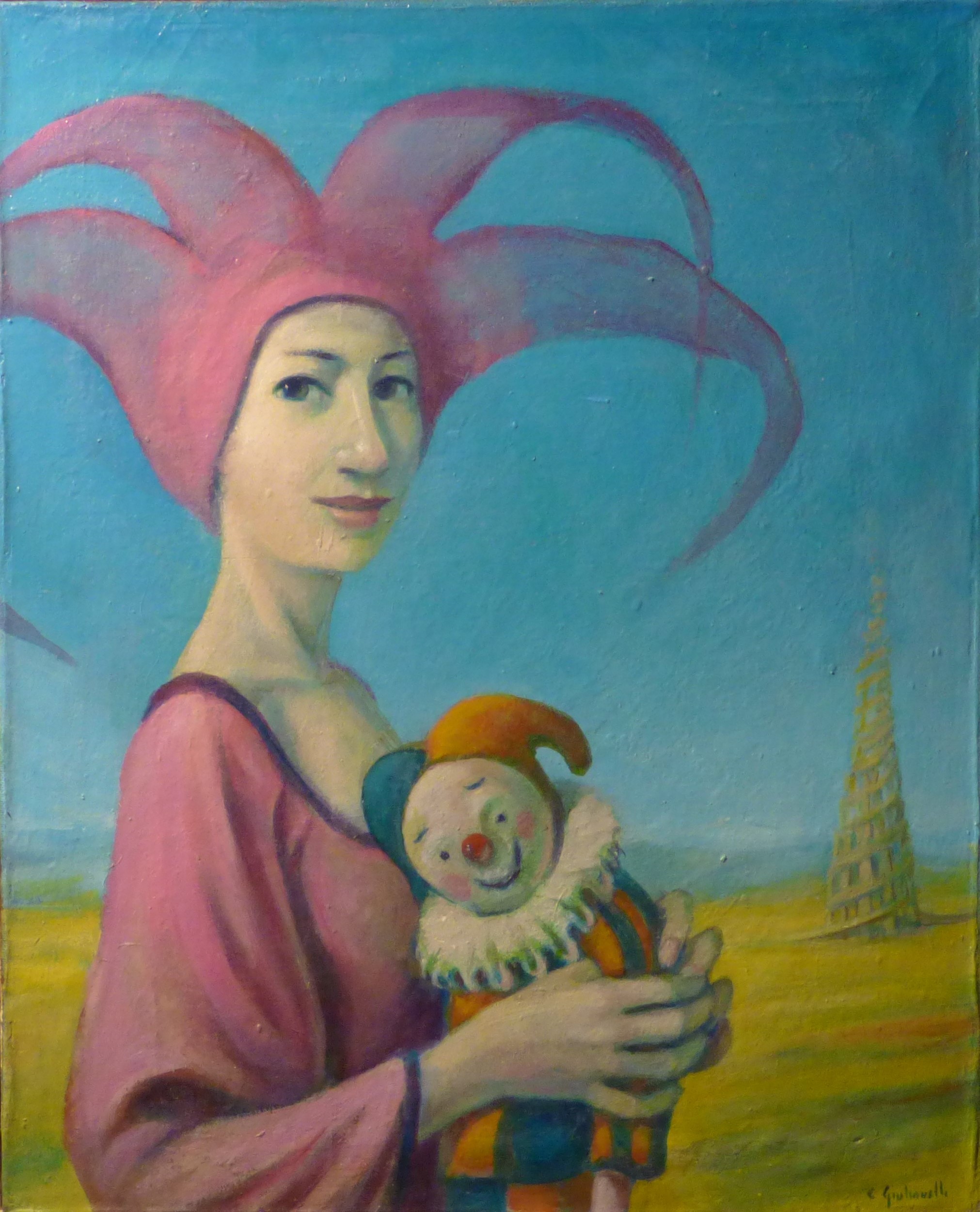
Claudio Giulianelli is a Roman artist who have done many major exhibitions in different parts of world and been in biennales. Most of his pictures, represent feminine subjects. They are mixture of reality and imagination, dream and mystic, memories and symbolism. These paintings have elements of Impressionism, Symbolism and Surrealism. His strong passion for art (in particular for the ancient one) led him to deepen the technique and study of painting through a careful observation of the works of the Masters together with the reading of texts of pictorial technique. Claudio despises the part of world where hypocrisy, chaos and confusion seems to predominate over good. Therefore he finds home in his own universe, a place where he experiences mystery and fascination. These paintings seem to express about the contemporary human behaviour and conditions. It looks like they suggest a sweet and quiet period of hybernation, opposing reality in order to discover peace and serenity.


Paintings of Claudio

The message that this artist seems to convey is one of regaining the true dimension of the existence through history and ourselves. The inspiration to the antique represents for this artist the opportunity to free his mind and create images that cast themselves to a new time of revolution in graphics.

Claudio Giulianelli was born in Rome on September 23rd, 1956 He lives and works in a very small town of Etruscan origin named Corchiano, located near Rome. Since childhood he used to draw masks, jesters and clowns. He was obsessed with clowns. The dames in his paintings represents nature. They are drawn as  beautiful and imposing. Shelooks upon the observer as if a queen. Whereas he draws the man as small figure like a puppet in the hands of nature. The man or puppet tries hard to define nature to understand her. But it is a hopeless task, a heroic task.

[Translation of this post into malayalam was published in Bindu P V's Column on Art and Times in the Prasadakan Monthly Magazine in Malayalam.]


Photos of the article published in 'Prasadakan' Monthly Magazine, in Malayalam language.


Sunday, October 18, 2020

Gopi Mangalath

There are many people who don multiple feathers in their hat. Versatile creative persons would be such people. They are not bound by their field of studies or their job, in whatever they do. They understand well that sheer creativity do not bring in bread always. One needs food always, bills needs to be paid. The concept of certain blue blooded critics and artists that the profession or studies of a person influencing/affecting their work and resulting in substandard works dosent bother these realistic and self respecting breed of creative people, who are willing to try out whatever that sets them free. Gopi Mangalath is one such person. He is a creative director, movie director, visual artist, writer, poet and columnist. He is a publisher too with Golden Jokes Books and Monthly. He dedicated his life for the new and unique ideas in arts and literature. He is a graduate of Botany, as well as Applied Arts ( BFA Applied Arts, from the Government College of Fine Arts in Thiruvananthapuram). Experimentation with texture, style, size, shape and colours are Gopi’s forte. He has conducted 8 exhibitions on paintings and sculptures and also participated in Kerala state Lalithakala Academy’s annual exhibition and painters camp etc. He received award for the Logo of Kochi Smart City. He has three Limca Book of World Records for First One Line Stories, First Film Role Book Design and First Abstract Film. He wrote the concise history of Cinema in miniature size in the form of a film role. The Abstract film by him is a murder mystery created without any title, dialogues or any animal, birds, human beings or not even an ant; but with a clear story line and characters. He also has 2 Best of India records. His poetry "Sterile Feelings' was translated and published into 'Poet', an the Intercontinental magazine . He wrote a column on visual art in a Malayalam newspaper's Sunday supplement for a year and his programmes have featured in TV and radio.


First film role book design that won him one of his three Limca Book of World Records.

One of his interviews


Logo designed by Gopi Mangalath for White Sanctum Art Gallery


Face of White Sanctum series of facebook based online exhibitions post designs designed by Gopi Mangalath


Gopi's creativity flows into various areas of art and literature. Bringing out novel methods in everything he deals with. He experiments with different styles of art... He doesn't look far for inspirations. His references are from things nearby. The cattle that graze in the nearby plots graze on to his colors and forms. His cow series of works have found much appreciation from galleries and connoisseurs. 


He also makes images inspired from local religious or ethnographic contexts and depicts them in his way giving respect to the image. 


His works flow even to the topics such as sensuality where the nature's procreating strength sways and intermingles to form sensuous images that "breathes life" in a lifeless canvas. 

[Images courtesy: Gopi Mangalath]

The artist, though from applied arts background and with work as a publisher etc to be sustainable, gives his best when he turns to art, whenever he can. He have been closely observing the art of many artists in Kerala consistently since past decades and that is why he is a natural critic of art works. His articles on art come in many monthlies and other media.


These four pictures are of his article in Yeyuthu Magazine published in September 2020. It gives a vivid a description of his native place along with an interesting communication with Guru Nithyachaithanya Yati on aesthetics and art. Gopi shared anecdotes about this beautiful series of doubts and their answers given by the Guru, without ever realising that they would feature as articles later. These can be referred by young artists stepping into a world where half knowledge is being decorated and displayed as the ultimate rules. The beauty of Gopi's writings are their no nonsense simplicity and experience, along with the serene descriptive flow almost like water. 

[Image courtesy: Gopi Mangalath and Yeyuthu Magazine]


Monday, October 5, 2020

An Artist who Infuses Color to Culture, Literature and Arts

Rick Hunt is an artist who learnt art from Franconia and Massachusetts College of Art for illustration and fine art. He also did a BS in psychology from Lesley University in Cambridge Massachusetts. He was mentored internationally by the artist Kenneth Westhaver. Later his mentor adviced him that one should go to art school, learn everything can and hone your skills...get out...and forget it all. He developed his style of painting which a mix of psychedelic/ pop/sci-fi/confessional. Rick’s work has been influenced mostly by musicians rather than other visual artists. He admire Jackson Pollock, De Kooning...Many inspirations just come from his life experience...Rick has ALWAYS created art ever since he could pick up a pencil. He feels that he became a serious artist at the age of twelve... Rick says that the music of Jimi Hendrix, Miles Davis, and most recently Anoushka Shankar is influencing his work... Rick created a series of paintings on Abenaki, the indigenous native American tribe along with the native American artists. This series of paintings focuses on creating Maine-based conversations like those taking place nationally about contemporary issues, as expressed through Native art. It is about Native identity in this society at this time, and the challenges one experiences living ‘Indian’ in our various ‘worlds’. In 2011, Rick met the famed actress, singer, author, poet, businesswoman, cultural icon and American scholar Angela Bowie in the social cyberworld of facebook. When Angela made “The Angie Bowie Show” page on Facebook, Rick did a two feet high by three feet long drawing for the title page and sent it to Angela in the mail. The beautiful painting became the title page and the beginning of their collaboration, which started with the book “Cat-Astrophe” which was published last year followed by “Fancy Footwork”. Rick illustrated poems of Angie for both her books. They also collaborated on two books of Rick’s artwork, “Gaucho Visions” and “Gaucho Visions II”, with Rick providing the images. They even had in exclusive show in radio, with “The Angie Bowie Barnett Show”. They started it as a forum for inviting their creative, talented friends to talk about themselves and their art, with all enjoying a spirit of fellowship, laughter and mutual appreciation. Rick is also illustrating a lot of David Bowie-esque type imagery because of all the projects he works with Angela Bowie. Rick also is part of a band The Dream Foundry where along with his friends Kevin Wallbank and Sally Sharp- Paulsen wrote and recorded songs from being in different places. They are an example of how changes in music technology, and shared objective can result in a band creating music in two different countries. The Dream Foundry had been graced with many brilliant portraits by Rick over the years; as with Angie and her poetry, no other artist could have expressed them and their sound perfectly through visual interpretation. Rick has been doing illustrations of songs as well as his brilliant illustrations of the band and Collective Rick’s lines and colors sway with the music of the band of Dream Foundry, with the poems of Angela and even with the social identity of the native tribe of America. Rick’s illustrations breathes life into the beautiful verses of Angela’s poetry and stories. It comes with thorough understanding that Rick has about the people, their culture, literature, art and music, that he is involved with. 


The malayalam version of this post was published in the malayalam monthly magazine 'Prasadakan' in its October 2020 edition.


Monday, September 21, 2020

Art and Artist's Thoughts During the Corona Pandemic

Pandemics like Covid-19 creates much difficulties in all respects, especially in health, financial and social aspects .  It is also a time when the morale of the people is at risk. It brought us face to face with the adverse situations and momentariness of life. Things we took for granted, become needs to luxuries.  This was also a wake up call to all of us. Adversities are stepping stones for newer heights through resilience.   

 This period was  also  about human pain such as reverse migration, loss of employment, economical difficulties, being helpless and stranded at foreign places, social distancing etc. Even in such dire circumstances the artists kept their love for art alive. The lack of availability of art materials made them look for alternate mediums. Art were created even at the isolated condition. This trend of resilience was expressed in different forms and ways through many artists in India and abroad. A few artists expressed their view regarding the current situations.


The first thing that comes to mind is that the artist lived this experience in his own country so we had different levels of danger.  Obviously I can talk about Italy.  Here with us most of the artists have experienced this moment of isolation as a challenge with themselves. I am stronger than Coronavirus and my art will never be stopped.  I have purchased 10 canvases and I painted every day for many hours and I have produced very special paintings .... 

Italian Artist Claudio Giulianelli 


 Claudio Giulianelli


A painting on Corona by Claudio Giulianelli

American artist Rick Hunt says: For me,creating art pretty much is a solitary event. I am feeling OK with the isolation because it doesn't feel like isolating myself,it is more the glory of SOLITUDE...My art and my creative process is meditation...the act of creating is a "ritual" that creates order out of chaos (whether it be located inner or outer...)...My favorite subject matter is "people". When drawing I am never alone...So, Isolating during this pandemic does not bother me so much. I usually am up at 4:00 in the morning to draw anyway!..I have not been focused on selling my work Bindu, for many years. I am content to present it so people can have a dialogue with it...I DO enjoy having my work published as books though and it is satisfying to me to see images gathered in a compact portfolio that people can hold and take their time with...I draw every day and during any free moment...My art has not been affected by the pandemic...


Rick Hunt

A painting on Corona by Rick “ Do not cough in my face” 

-       

The art market in Udaipur is affected by the slowdown due to corona. Udaipur is a tourists city and all handicraft ant art shop's are closed.  Most of art gallery are permanently closed. In corona time as Iam a teacher I was on duty at the District Corona control room duty in 3 shifts. One online sculpture camp was  done. Hope soon I will get one project. So for me it  is OK. " Hemant is a stone sculptor from Udaipur and works generally in large pieces of stones like granite, marble etc.


Some of the beautiful sculptures done by Sculptor Hemant Joshi during the Corona time


Hemant Joshi turning the stones to beauties

Fulgor Silvi does installations with the works of other artists who provide him their paintings, to be stuck to his beard. His intention is to display art anywhere, by shattering the concepts of galleries and specific spaces to display art. The installations are made with the works of Alfonso Caccavale. Fulgor is the owner of the PERFORMAMCE BEARD GALLERY. He is the Artist who becomes Gallery ... with his own beard (Hanging Gallery).


Fulgor Silvi, Performance artist and Gallery owner, PERFORMAMCE BEARD GALLERY, Italy.

Through all this stage what stood out was the resilience of artist’s or cultural heritage practitioners. Most of them continued with their art work from the comfort of their homes. This in some cases meant lack of space and seclusion. Some artists who used to do their paintings in large canvases shifted to small works. While some artists  were constantly working on their incomplete works. others created new works. Some artists who had difficulty to obtain paint or other materials required for making their art works, shifted to other easily available materials as well as unusual medium. Art came up in medium ranging from cooked chapati’s to masks. Just like the ‘Chekkuty’ dolls made from the damaged yarns of Chendamangalam after the flood in Kerala in 2018, painted masks became a rage with people. Folk art such as Madhubani were the quick to reach out to people in revamped and economical utility items as per the need of the time.  Adaptability of such art forms to the changing times can be seen as the reason for their popularity and reason for their survival.

This pandemic, the lockdowns etc. have atleast for now shattered  the traditional business model of  galleries and outreach of the artists. The unnecessary formal canonicality place for or of Art just vanished in the upsurge in the online outreach events. Curators/ Galleries have come up with ideas such as webinars, online workshops and online exhibitions. Artists grabbed this opportunity.  The spirit of resilience of artists is seen to its utmost expression in this year, amidst the tough times. 


Edited version of this article featured in the malayalam monthly magazine Eyuthu in its September 2020 edition. The following are the pictures of it:


- Bindu P V


Sunday, July 12, 2020

Narayana Bhattathiri and Malayalam Calligraphy art

About Narayan Bhattathiri and his Works:

Narayana Bhattathiri is a malayalam caligraphy artist, who has exhibited his works in India and abroad.

His workshops were organized at:

Kochi Biennale 2016-17,

Callifest, Navi Mumbai,

Trivandrum, Kochi, Thrissur and Kozhikode.


He was the Festival Director of the First National calligraphy Festival of Kerala in 2019.

Bhattathiri is the receipient of the Jikji Excellence Award in International Calligraphy for 2017 and 2018.

Calligraphy work permanently exhibited in the Calligraphy Stone park, Harbin, China.

A Novel based calligraphy series (30 works) permanently exhibited in Thrazak, Palakkad, Kerala, India.

He is a regular participant at the International TypoDay Conferences for the past couple of years, and has been part of various upcoming calligraphy workshops all around the country.

Bhattathiri's Calligraphy:

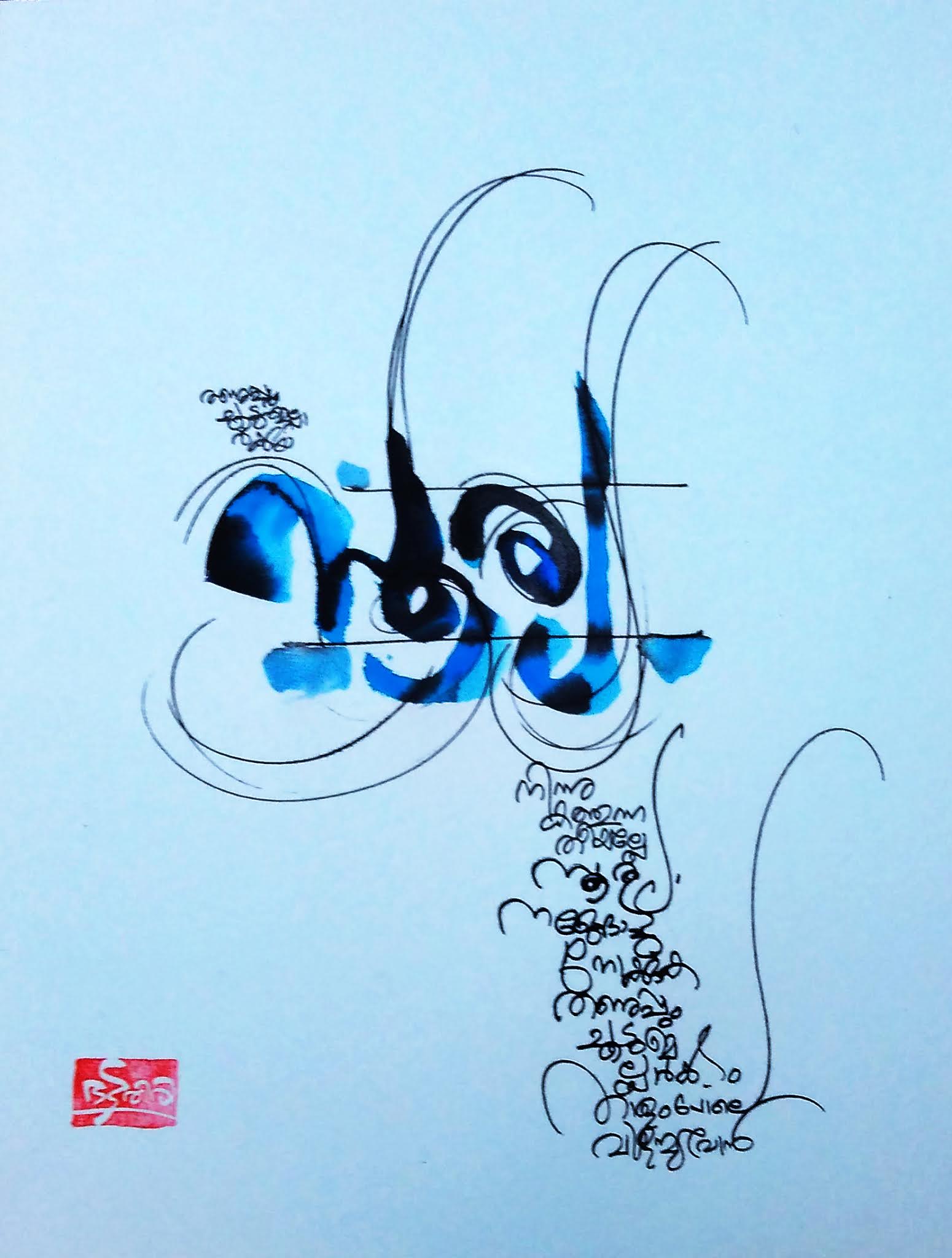
In Malayalam, the romance with the alphabet has a long history; it can be found in the various palm leaf manuscripts, and later in early stone types, block prints etc. before it blossomed in print. Written, painted and printed words are a ubiquitous presence in Kerala; our public spaces are inundated with words; there are graffiti on all the walls, posters and billboards on the pillars and posts stare at us from all around. With the apparently varied ‘choice’ of fonts and the ‘freedom’ to adapt and adopt, the encounter with the shape and size, gravity and lightness, tone and tenor of the alphabet became mechanical and ‘ordinary’, over the years. Bhattathiri’s word art is an attempt to re-enchant the romance with alphabets, reinvigorating the encounter with new energies, aesthetics and playful flights.

This exhibition presents a miniscule selection from the thousands of titles that Bhattathiri has designed and drawn over the last four decades. He brings to Malayalam alphabet art a new vigour and endless innovations, by working his way through the contours and margins, the twists and turns, the dots and vowls of Malayalam alphabets. He recreates the awe and wonder of that primal encounter between meaning and word, the abstract signification and the concrete form and shape of the alphabet. His art practice is one that works with, through and around the tense and arbitrary, but deeply resonant relationship between the word and its meaning, the alphabet and its sound.

Never a conformist to any style or school, he is vibrantly eclectic in his approach to his art of shaping and moulding alphabets, curling and straightening, flourishing and chiseling them into affects, meanings, emotions, always creating, a visual impact of a visceral and striking kind. In this process, he freely plays with forms and styles – sometimes they are minimal, muted and rigid, other times, flowery and flamboyant, emotional and loud.

If one browses through the thousands of word designs created by Bhattathiri, one will be astounded by their variety. His designs approach and negotiate with the alphabet in a profound manner; alphabets and words are not mere potential objects of ‘beauty’ or defined functionality for him; instead his art intensely engages with the meanings, sign values, sound, genre (story, novel, film), and space (magazine, book, paper, poster..); these factors decide the size, shape, strokes, texture, and medium of his art work. Looking at his works, one feels the word-forms emerging out of meanings, movements, sound, affects, emotions, bhava and rasa associated with them.
He uses the alphabet styles of various languages and cultures – their shape, size, flow, serifs, ascenders, descenders, stems, finials, apex, brackets, leaps and loops, to adopt, coax and caress them into Malayalam alphabets. As a result, one can find in his work traces of postures and slants, the flows and joints of Chinese, Arabic, Sanskrit, Hindi, etc; they are employed to animate words to resonate with their cultural/linguistic roots and to make them converse with Malayalam. Likewise, his ambigrams are ‘alphabetic flights of imagination’, they are complex and fascinating creations that combine meaning and form in inimitably playful ways.

Bhattathiri’s words and alphabets rain, burn, flow, flicker, fly, fall, slide, float, frown, smile, giggle, ponder, worry and flutter, in tune with the trajectories of the denotations and connotations, that illuminate and ignite their semiotic, indexical and symbolic energies.


Three of Narayana Bhattathiri's Malayalam Calligraphy Works:


A few links to read further about his works: 


His beautiful malayalam calligraphy works have featured in movies, and even recently in the  Calligraphy event dedicated to the National Anthem

Kalakaumudi news report about the Calligraphy event dedicated to the National Anthem , can be viewed at the following link.


https://www.youtube.com/watch?v=al-wFCU2P0g&feature=share&fbclid=IwAR1E-6pvMsC6uURk0qE9aSowwQsXvz7wp2DJHgkk1I6YCrTOid4R0IB5_bw


He also did calligraphy works based on the novel at Thasrak, the village in Palakkad made famous by OV Vijayan’s seminal work, Khasakkinte Ithihasam, to mark the golden jubilee year of the book. For more details, please read the news by The Hindu:


Henry Grahn Hermunen

Experts from a short interview with Henry Grahn Hermunen from Finland-Sweden   Henry Grahn Hermunen is a contemporary artist living in F...